Range Repair
Viking Burner Ticks But Will Not Light: A Denver Diagnosis
The ticking is the spark, so the gas is rarely the problem. Here is what that sound tells you, the four faults it usually turns out to be, what you can safely check yourself, and where Denver's altitude comes into it.
Written by
Clifford Nakamura
Service technician — controls and intermittent faults · 22 years in the trade
- Viking appliances
- intermittent electrical faults
- connector and harness repair
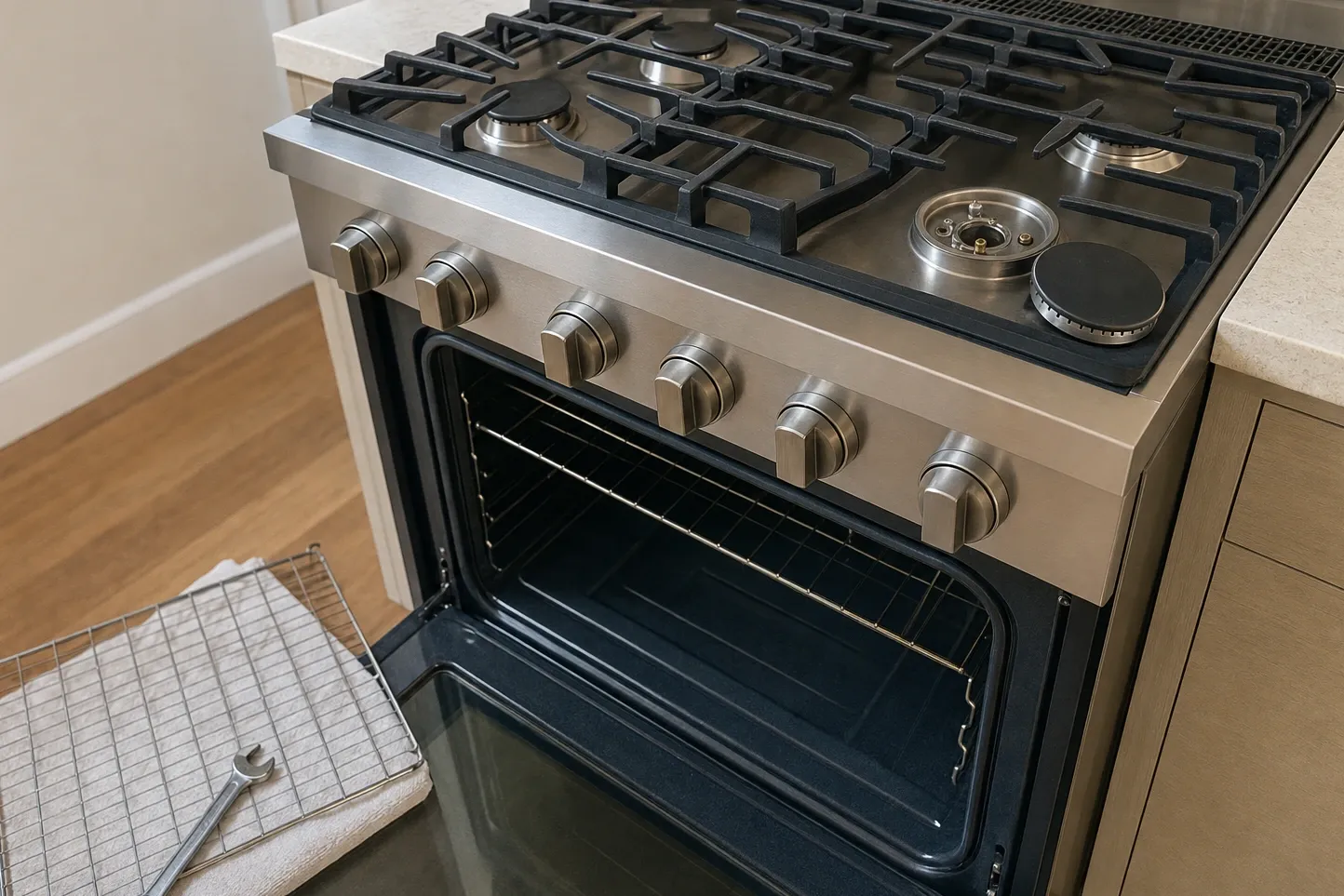
A burner that clicks steadily and never catches is the most common call we take on Viking cooking equipment in Denver, and it is also the one where the diagnosis is most often guessed wrong. The instinct is to assume the gas supply. The ticking itself says otherwise.
That sound is the spark generator firing. It only runs when the valve behind the knob is open, which means gas is being asked for and the ignition circuit is working hard enough to make noise. Something is stopping the spark and the gas from meeting each other in the right place.
What the ticking actually is
One knob movement does two jobs at once. It cracks the burner valve open, and it makes an electrical contact that wakes the spark module. From there the module pulses — high voltage, several times a second, down a lead to the electrode standing in the burner ring. Take the cap off and you can see it: a small pin of ceramic and metal parked beside the ports.
For the burner to light, that spark has to jump from the electrode tip to the nearest piece of grounded metal through the gas stream. Everything in the list below is a variation on the same failure: the spark is happening, but not where the gas is.
One useful consequence: if the ticking stops the instant the flame appears, the sensing side of the circuit is healthy. If it keeps ticking after lighting, note that — it changes the diagnosis completely.
The four things it usually turns out to be
A cracked electrode. The ceramic insulator takes the heat of every meal and eventually develops a hairline crack. The spark then tracks down the crack to the burner body rather than jumping across the gas. You often see a faint grey or brown carbon line on the ceramic where it has been going. This is the single most common cause on ranges past their first few years.
A chafed or wet spark lead. The lead runs from the module up through the burner box. Where it passes a bracket it can rub through, and the pulse finds earth early. Moisture does the same thing without any damage at all: after a boil-over or an enthusiastic clean, a damp electrode will tick uselessly for a day or two and then start working again on its own.
A cap that is not sitting down properly. Viking sealed burners give the cap one correct position and no other, and it has to lie flat on the head. Drop one, or set it back a few degrees out after a clean, and the ring of ports shifts away from the electrode. Nothing is wrong with the spark. The gas is simply turning up somewhere the spark is not.
Blocked ports. Grease from roasting runs down under the cap and sets. The ports nearest the electrode fill first, so gas stops emerging exactly where the spark is. On a burner that has been used hard for years, this and the cracked electrode account for most of what we find.
What you can safely check yourself
Turn the burner off, let everything cool, then:
- Lift the grate and the burner cap. Look at the electrode from the side. A crack, a chip, or a dark tracking line means the part is finished.
- Check the cap is seated flat and in its correct orientation. Lift it and set it back deliberately rather than assuming.
- Look into the port ring. If the holes nearest the electrode are dull with baked grease, clear them with a stiff wire or a straightened paperclip — never a toothpick, which snaps off inside.
- Dry everything with a cloth if there has been a spill, and give it a day.
- Try the other burners. If every one of them ticks and none light, that points at the module or the gas side rather than at one electrode.
Two things not to do. Do not take the cooktop apart to reach the spark module: it delivers thousands of volts and it is not a component to prod at while it is live. And if you can smell gas at any point, stop, open a window, leave the house and call the utility before you call us.
Where Denver’s altitude comes into it
Denver sits a mile above sea level, so there is roughly seventeen per cent less air in every lungful — and in every cubic foot arriving at a burner. Gas equipment shipped on factory settings assumes sea level. Run it here and the mixture is rich.
Rich burners misbehave in a way that looks like an ignition fault. Flames climb tall and orange instead of sitting blue and tight, pans pick up soot on their bottoms, and the simmer setting will not hold because there is not enough air to sustain a small flame. A burner can also light on the third or fourth attempt rather than the first, which is where the two problems get confused.
The fix is not cleaning. It is orifices sized for this elevation, regulator pressure checked with a manometer, and any air adjustment set to match. We see this most often on ranges that arrived during a remodel — the appliance moved, the gas line was reworked, and nobody re-jetted anything. A range that has been in the same Denver kitchen since it was installed and has always simmered properly is unlikely to be an altitude case.
When it is worth calling someone out
Call if the electrode is visibly cracked, if the lead is damaged, if every burner ticks and nothing lights, or if a burner lights and then quietly dies a minute later. All four need parts or a meter, and the last one is a flame-sensing or safety-valve question rather than an ignition one.
Call sooner if you have tall orange flames or soot on your pans, because that is combustion, not inconvenience — and it is worth having the altitude setup checked properly rather than living with a range that has never been right.
If the ticking started the day after a big spill and the burner is otherwise healthy, give it forty-eight hours first. Sometimes the machine fixes itself, and we would rather tell you that on the phone.
Follow-up questions
Is it safe to keep pressing the knob while it ticks?
For a few seconds at a time, yes — the spark is designed to run while gas flows. If it has not lit within five or six seconds, turn the knob fully off, wait a minute for the gas to clear, and try once more. Do not stand there sparking it for a minute at a stretch, and stop altogether if you can smell gas.
One burner is dead but the others light. Is that still the spark module?
Usually not. A module that has failed takes every burner with it, because they share it. One dead burner with the others working points at that burner's own electrode, its lead, or a blocked port ring — all local to the one position.
The burner lights and then goes out about a minute later. Same fault?
No, that is a different circuit. Lighting proves ignition works; going out afterwards means the flame is not being sensed or the safety valve is closing. It is a common pattern when grease has coated the sensor or the ports are partly blocked, and it needs a meter on it rather than cleaning alone.